Osmosis, Osmolality and Osmolarity
This topic explains how water moves across cell membranes and how solute concentration is measured.
For the exam, the focus is on predicting:
- Direction of water movement
- Effect of fluid tonicity on cells
- Basic understanding of osmolality
Key point: Water movement is determined by solute concentration
Osmosis
Osmosis is the passive movement of water across a semipermeable membrane.
Water moves from areas of low solute concentration to areas of high solute concentration.
This movement occurs down an osmotic gradient until equilibrium is reached.
Key point: Water moves towards higher solute concentration.
Tonicity and Cell Effects
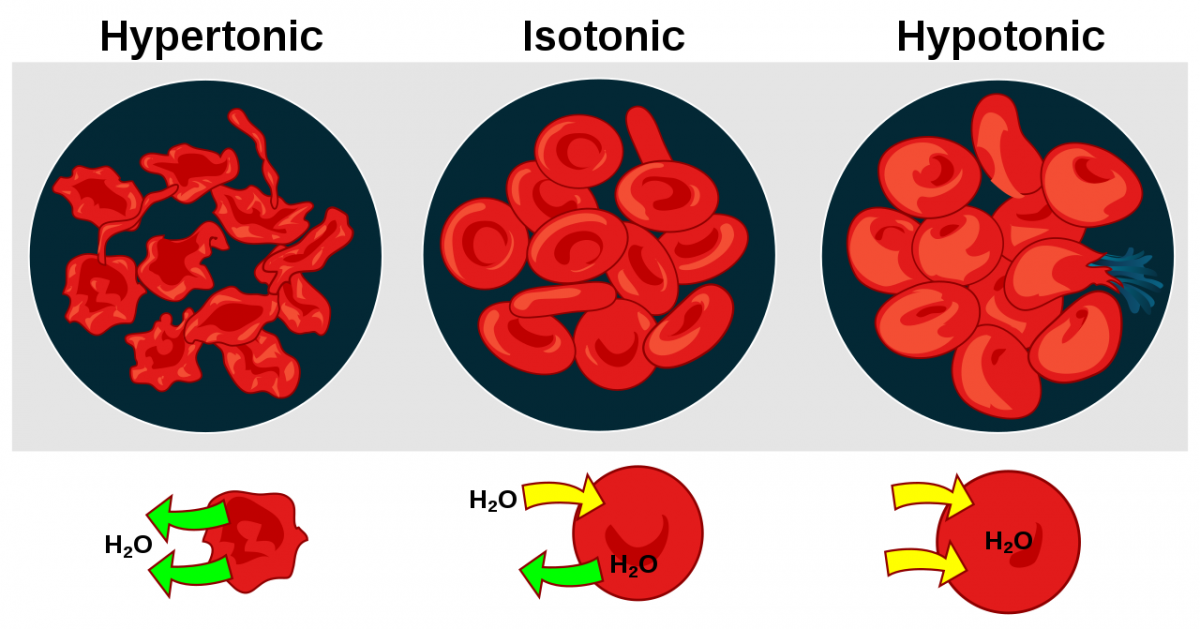
Tonicity describes how a fluid affects cell volume. It depends on solutes that cannot cross the cell membrane.
Isotonic fluid
Isotonic fluid has the same solute concentration as plasma:
- No net movement of water
- Cell size remains unchanged
Hypertonic fluid
Hypertonic fluid has a higher solute concentration than plasma:
- Water moves out of cells
- Cells shrink
Hypotonic fluid
Hypotonic fluid has a lower solute concentration than plasma.
- Water moves into cells
- Cells swell
Exam rule:
- Hypertonic → cells shrink
- Hypotonic → cells swell
These principles explain how cells respond to intravenous fluids and changes in plasma solute concentration in clinical scenarios.
Applied example
A patient given hypertonic saline will have water move out of cells, causing cellular shrinkage.
A patient given excess free water will have water move into cells, causing cellular swelling
Fluid Loss and Tonicity
Loss of fluid from the body affects extracellular fluid (ECF) volume and osmolality.
Sweat is hypotonic compared to plasma, meaning more water is lost than solute.
This increases ECF osmolality, making it hypertonic relative to intracellular fluid.
Water then moves out of cells into the extracellular space, causing cells to shrink.
Key point: Hypotonic fluid loss → hypertonic ECF → water leaves cells
Osmolality and Osmolarity
These terms describe the concentration of solutes in a solution.
They are closely related and often used interchangeably in clinical practice, but have different definitions.
Osmolality
Osmolality is the number of osmotically active particles per kilogram of solvent.
It is the preferred clinical measure:
- Units: mOsmol/kg
- Directly measured in the laboratory
- Normal range: 280–295 mOsmol/kg
Osmolality is clinically important because it determines the movement of water between the intracellular and extracellular compartments.
Osmolarity
Osmolarity is the number of osmotically active particles per litre of solution.
It is usually a calculated value rather than directly measured:
- Units: mmol/L
- Derived from serum solute concentrations
In plasma, osmolality is mainly determined by sodium and its associated anions.
This links directly to the higher sodium concentration in extracellular fluid.
Exam rule: Plasma osmolality → mainly determined by sodium
Key differences
The difference between osmolality and osmolarity is small in clinical practice.
Osmolality is more accurate because it is not affected by temperature or volume changes.
Key point:
- Osmolality is measured
- Osmolarity is calculated
Effective Osmoles and Tonicity
Not all solutes contribute to water movement. Only solutes that cannot cross the cell membrane affect tonicity.
Urea can cross cell membranes freely. It contributes to measured osmolality but does not cause water movement.
Key point: Urea affects osmolality but not tonicity
Osmolarity Calculation
A simple estimate of plasma osmolarity can be made using:
- 2 × sodium + glucose + urea
All values are in mmol/L.
This reflects the major contributors to plasma osmolality.
Linking Osmolality to Osmosis
Osmolality determines the direction of water movement.
- Higher osmolality → water moves towards it
- Lower osmolality → water moves away from it
Exam rule: Water follows solute → higher concentration pulls water
Clinical Relevance
This topic is tested using simple patterns.
You will be asked to predict:
- Water movement
- Cell swelling or shrinking
- Effects of intravenous fluids
Key Exam Tips
Questions focus on predicting what happens to cells when solute concentration changes.
In every question, focus on:
- Solute concentration
- Direction of water movement
- Effect on cell size
Common traps to avoid:
- Thinking water moves towards lower solute concentration
- Confusing osmolality with volume
- Over-focusing on calculations
- Forgetting tonicity effects
Exam rule: Water follows solute → higher concentration pulls water