Synaptic Transmission
A synapse allows communication between neurones or between a neurone and an effector cell.
This occurs via neurotransmission, where an electrical signal is converted into a chemical signal and then back into an electrical response.
Key point: Synapse = electrical signal → chemical transmission → electrical response
Overview of Synaptic Transmission
Synaptic transmission occurs in a sequence of steps.
These steps follow a consistent pattern:
- Synthesis and storage of neurotransmitter
- Release into the synaptic cleft
- Binding to postsynaptic receptors
- Postsynaptic response
- Removal or inactivation of neurotransmitter
Exam rule: Synapse sequence → release → bind → respond → remove
Synthesis and Storage of Neurotransmitters
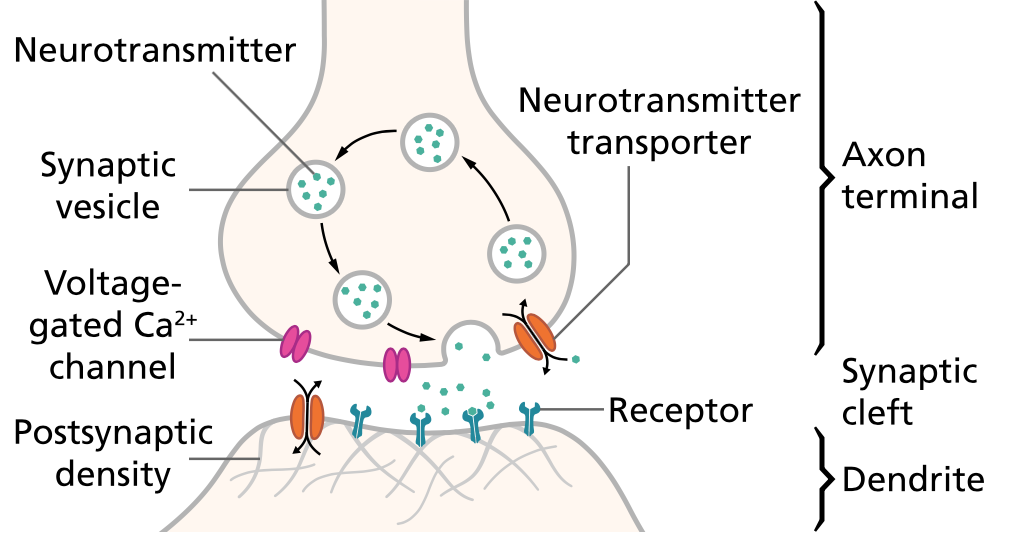
Neurotransmitters are produced within neurones and stored in vesicles at the synaptic terminal.
Different neurotransmitters are synthesised in different locations:
- Acetylcholine is synthesised in the axon terminal.
- Monoamines such as noradrenaline and dopamine are synthesised from amino acids.
- Peptide neurotransmitters are synthesised in the cell body and transported to the synapse.
Key point: Location of synthesis differs by neurotransmitter type
Exam rule:
- ACh → axon terminal
- Peptides → cell body
Neurotransmitter Release
Neurotransmitter release is triggered by arrival of an action potential at the presynaptic terminal.
This causes depolarisation and opening of voltage-gated calcium channels.
Calcium enters the presynaptic neurone and triggers vesicle fusion with the membrane.
This results in exocytosis of neurotransmitter into the synaptic cleft.
Exam rule: Neurotransmitter release → presynaptic Ca²⁺ influx
Postsynaptic Receptors and Response
After release, the neurotransmitter diffuses across the synaptic cleft and binds to receptors.
There are two main receptor types.
Ionotropic receptors:
- Ligand-gated ion channels
- They produce a rapid and short-lived response
Metabotropic receptors:
- G-protein coupled receptors
- They produce a slower but longer-lasting response
Key point:
- Ionotropic = fast
- Metabotropic = slower but prolonged
Termination of Neurotransmitter Action
Neurotransmitter action must be rapidly terminated to allow precise signalling.
This occurs by three main mechanisms:
- Reuptake into the presynaptic neurone
- Enzymatic breakdown
- Diffusion away from the synapse
Different neurotransmitters are handled differently:
- Acetylcholine is broken down in the synaptic cleft by acetylcholinesterase.
- Monoamines such as noradrenaline are primarily reuptaken and then metabolised by monoamine oxidase.
- Catecholamines may also be degraded extracellularly by catechol-O-methyltransferase.
Key point: Termination method depends on neurotransmitter type
Exam rule:
- ACh → cleft breakdown by AChE
- Monoamines → reuptake then MAO
Summation
Synaptic inputs are integrated at the postsynaptic neurone.
Two mechanisms allow signals to reach threshold:
- Temporal summation occurs when one neurone fires repeatedly.
- Spatial summation occurs when multiple neurones fire simultaneously.
Key point: Summation determines whether an action potential is generated
Exam rule:
- Temporal = repeated input
- Spatial = multiple inputs
Clinical Relevance
These mechanisms explain common clinical presentations:
- Acetylcholinesterase inhibition → cholinergic excess
- Calcium channel blockade → reduced neurotransmitter release
- Monoamine reuptake inhibition → prolonged neurotransmitter action
Typical presentation:
- Cholinergic excess → salivation, bronchospasm, bradycardia
Key Exam Tips
Synaptic transmission questions test mechanisms rather than definitions.
In every question, focus on:
- Where the neurotransmitter is made
- How it is released
- How it is removed
Common traps to avoid:
- Confusing ACh breakdown with monoamine metabolism
- Forgetting calcium triggers release
- Mixing up synthesis location of peptides and ACh
- Confusing receptor types and response speed