What is Evidence-based Medicine?

August 20, 2022


Evidence-based medicine is the term used to describe the process of systematically reviewing, appraising and using the findings of clinical research to assist with the delivery of optimum clinical care to patients.

The most commonly quoted definition of evidence-based medicine is the one provided by Dr. David Sackett in his 1996 BMJ publication:

Evidence-based medicine is the conscientious, explicit and judicious use of current best evidence in making decisions about the care of the individual patient. It means integrating individual clinical expertise with the best available external clinical evidence from systematic research.


The five steps of evidence-based medicine

Evidence-based medicine can be considered to be a 5-step process:

  1. Assess the patient

The process of assessing the patient results in the development of a clinical problem.

  1. Ask the question

Formulate a well-structured clinical question based upon the clinical problem that has arisen in this case.

  1. Acquire the evidence

Search the literature and resources for the best available evidence to answer the clinical question.

  1. Appraise the evidence

Review and critically appraise the evidence that you have found, assessing its validity, applicability and quality.

  1. Apply your findings

Now return to the patient and implement changes based on the evidence that you have discovered. Integrate the evidence with your own clinical expertise but also take into account the preferences of the patient. Monitor this process and self-evaluate your own performance.


The evidence-based medicine triad 

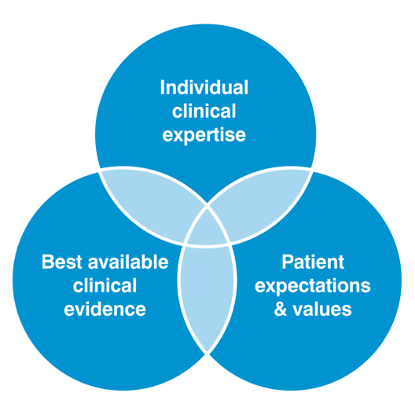
It can, therefore, be seen that the practice of evidence-based medicine can be considered to consist of the following triad:

  • Individual clinical expertise
  • Best available external clinical evidence
  • Patient expectations and values


The triad of evidence-based medicine


Header image used on licence from Shutterstock


Medical Exam Prep would like to thank Dr. Marc Barton for permission to reproduce this extract from his book ‘Evidence-Based Medicine & Statistics for Medical Exams’.

About Dr. Marc Barton

Dr. Marc Barton qualified from Imperial College School of Medicine in 2001. Since that time, he has worked in a variety of different medical specialities. He worked as a GP partner from 2006 until 2008 and, more recently, as a higher specialist trainee in Emergency Medicine.

‘Evidence-Based Medicine & Statistics for Medical Exams’ is available for purchase here.
Other Articles

Ingested Foreign Bodies: An Overview

October 20, 2025

Nerve Agents: Recognition and Management in Clinical Practice

September 20, 2025

Arterial Blood Gase Analysis – At a Glance

September 10, 2025

Ischaemic Bowel

May 20, 2025

Septic Arthritis

April 10, 2025

The Blurting Technique: A Simple Way to Boost Recall and Understanding

March 10, 2025

The 2357 Study Hack: A Smarter Way to Remember What You Learn

February 10, 2025

Mastering Single Best Answer Questions

January 10, 2025

Study in Sprints, Not Marathons: The Pomodoro Method Works

December 10, 2024

Stay Engaged, Retain More: Transform Your Study Routine with Interleaving

November 10, 2024

Cardiac Arrest in Pregnancy: Critical Considerations

September 20, 2024

How to Approach Your Exam Day: A Guide for Medical Students and Doctors

August 10, 2024

Life Threatening Chest Injuries in Trauma – The Killer Six

April 20, 2024

Mastering the Symphony of the Heart: A Comprehensive Guide to the Heart Sounds

July 20, 2023

Building a Career in Global Health and Expedition Medicine

January 20, 2023

Recognising Myocardial Infarction Patterns on the ECG

June 10, 2022

How To Read a Paediatric ECG

February 10, 2021

Compartments and Fluid Spaces in Health

October 20, 2020

Diagnosing Pneumonia on Chest X-Ray

December 20, 2019

How to Differentiate Bell’s Palsy from Stroke

June 10, 2019

Arterial Line Placement

May 20, 2019

Survival Tips for Night Shifts

December 20, 2018

Arterial Blood Gas Analysis Part 2 – Interpreting the Results

April 10, 2018

Arterial Blood Gas Analysis Part 1 – The Basics

March 10, 2018

The Beginners Guide to Non-Invasive Ventilation

January 20, 2018

Dealing With Stress and Anxiety

January 10, 2018

What to Expect at Your Emergency Medicine Training Post Interview

November 20, 2017

I Wish I Had Heard This Advice Before Applying For An Emergency Medicine Training Post

August 20, 2017

The Oxygenator Assessment – Part 2

November 21, 2016

The Oxygenator Assessment – Part 1

October 20, 2016

Why Antarctica?

August 23, 2016

The Basics of ECG Interpretation (Part 3 – Waves, Segments & Intervals)

March 06, 2016

The Basics of ECG Interpretation (Part 2 – Rate, Rhythm and Axis)

February 07, 2016

The Basics of ECG Interpretation (Part 1 – Anatomy and Physiology)

January 08, 2016

The Art of Breaking Bad News

October 10, 2015

What Doctors Are Saying